Upholstery gets a fraction of the moisture tolerance that carpet does, and that’s exactly why upholstery cleaning with encapsulation products has become the default approach for a lot of professionals instead of an afterthought. A cushion or chair back can’t handle the water load of a full extraction pass the way a floor can, and it can’t sit around drying for hours in an occupied living room or office without becoming a problem of its own.
Encapsulation chemistry solves both issues at once — low moisture going in, and a faster path to dry fabric coming out. Here’s how to actually run it on upholstery instead of just assuming what works on carpet transfers over directly.
Why Upholstery Cleaning with Encapsulation Products Works Better Than Extraction Here
Extraction pushes water and cleaning solution into the fabric and then pulls most of it back out — but ‘most’ is the operative word, and upholstery padding holds onto residual moisture far longer than carpet backing does. Over-wet a cushion and you’re looking at a musty smell, a ring that reappears as it dries, or in the worst cases mildew forming inside the padding where nobody can see it until it’s already a problem.
Encapsulation uses a fraction of the water an extraction pass does. The polymer suspends soil away from the fiber as the fabric dries, and you’re left with a light residue you vacuum or brush out once everything is fully dry — not a cushion that stays damp for the rest of the day.
The Products Built for This
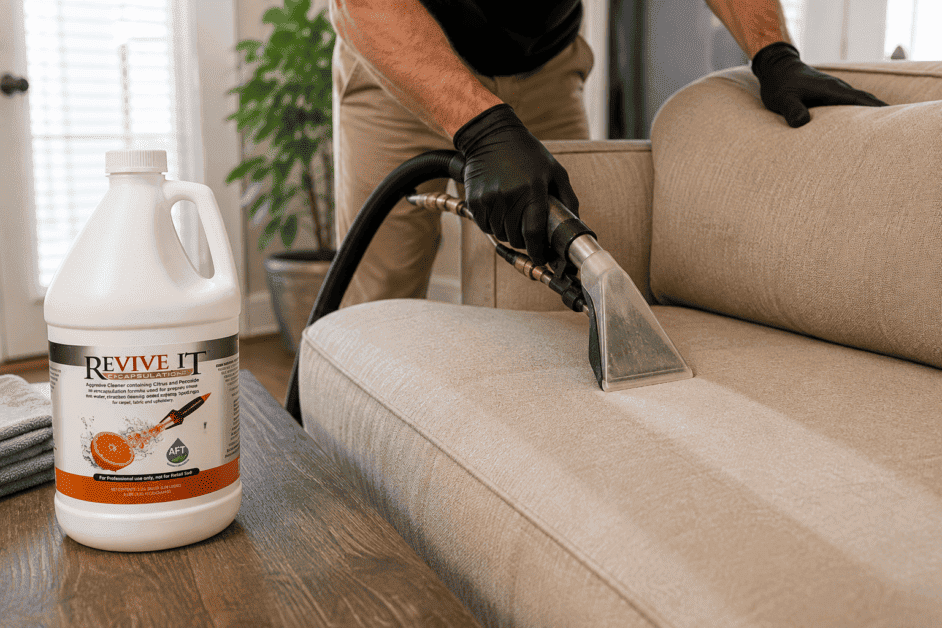
Revive iT Rocket is labeled for bonnet, low-moisture, extraction pre-spray, and upholstery use, which makes it the practical default for most upholstery jobs. Its T3H dustless polymers mean it doesn’t leave the crystallizing residue or crunchy feel on fabric that a lower-quality encap detergent can, and the citrus-oxy blend handles organic staining — food, drink, general body oils — without needing a separate product for each type of soil.
Pre-Treating Upholstery Before the Main Clean
For set-in or organic stains on upholstery, Revive iT Oxy Spotter works as a direct pre-treatment before the main pass. It’s built around a stabilized hydrogen peroxide that doesn’t release its cleaning power until it contacts real soil or bacteria, so it’s gentle on fabric that hasn’t been heavily soiled while still tackling the sections that have. Apply it to the stained area, give it a short dwell, and let Revive iT Rocket handle the rest of the piece. Don’t forget to rinse if using extraction with Radical Rinse.
Check the Fabric Before You Start
Not every upholstery fabric tolerates a water-based cleaner the same way. Before treating a piece you haven’t cleaned before, check for a manufacturer cleaning code tag, and always test an inconspicuous area — the underside of a cushion or the back of an arm — before committing to the full piece. Natural fibers and some specialty weaves are more sensitive to moisture and agitation than synthetic blends, and a quick spot test tells you in a couple of minutes what a bad reaction on the whole piece would tell you the expensive way.
Applying Encapsulation Chemistry to Upholstery
Start conservatively — light coverage rather than a heavy application — and adjust based on how the fabric responds and how soiled the piece actually is. Upholstery generally needs less product per square foot than carpet simply because there’s less fiber mass to work through, and it’s easier to over-wet a cushion than it is to over-wet a floor.
Work in manageable sections with light agitation from a soft brush or upholstery attachment rather than the more aggressive pad or bonnet drive you’d use on carpet. Upholstery fabric is thinner and often more loosely woven, so it doesn’t need — and generally can’t handle — the same mechanical force a carpet fiber can absorb without damage.
Give It Time to Dry Before Use
Because encapsulation uses low moisture to begin with, upholstery treated this way typically dries faster than it would after an extraction pass, but it still needs real dry time before the piece goes back into regular use. Keep airflow moving across the piece — a fan or open window helps — and avoid sitting on or covering treated furniture until it’s fully dry, since trapped moisture against fabric is exactly the condition that causes the odor and residue problems encapsulation is supposed to avoid in the first place.
Frequently Asked Questions
Can you use the same encapsulation detergent on upholstery and carpet?
Yes. Revive iT Rocket is labeled for both, along with bonnet, low-moisture, and extraction pre-spray use, so you don’t need a separate product line for upholstery jobs.
Is encapsulation safe for delicate or natural-fiber upholstery?
Generally yes with a neutral-to-mild pH product, but always test an inconspicuous area first and check for a manufacturer cleaning code before treating natural fibers or specialty weaves you haven’t worked with before.
How long should upholstery dry after encapsulation cleaning?
It varies by fabric and airflow, but plan for the piece to stay untouched with good ventilation until it’s fully dry to the touch — sitting on or covering damp fabric traps moisture and can cause the odor and residue issues low-moisture cleaning is meant to prevent.
Does encapsulation remove tough stains from upholstery as well as extraction?
For most organic and traffic-related staining, yes, especially when paired with a pre-treatment spotter on set-in spots. Extraction still has an edge on very heavy, deeply saturated contamination, but that’s uncommon on upholstery compared to carpet.
A Cleaner, Faster Way to Handle Upholstery
Upholstery cleaning with encapsulation products comes down to using less water going in and giving the fabric a real path to dry fast coming out. Revive iT Rocket and Revive iT Oxy Spotter cover the full job — general cleaning and stain pre-treatment — without switching chemistry between the floor and the furniture in the same room.