The average lifespan of professional carpet cleaning solutions isn’t measured in months on a shelf — it’s measured in ready-to-use gallons you get out of a bottle before you’re placing another order. Two products at the same volume can produce wildly different job counts, and the gap almost always comes down to one thing: how much of that container is active chemistry versus water and filler you’re paying to ship and store.
Run the math on your own case costs and you’ll usually find the “cheaper” bottle isn’t cheaper at all once you factor in how fast you’re burning through it.
What Determines the Average Lifespan of Professional Carpet Cleaning Solutions on Your Van
Concentration ratio determines the average lifespan of professional carpet cleaning solutions more than any other variable, including fiber type or soil load. A detergent that calls for 4 ounces per gallon burns through a quart in under 8 RTU gallons. A formula built to run at 1 ounce per 3 gallons stretches that same quart across a much larger job count before you’re back on the reorder page.
Ready-to-Use Yield Per Quart
A quart of a genuinely concentrated, zero-water formula can produce close to 90 RTU gallons for carpet work and well over 150 RTU gallons when you’re running hard floors or an auto scrubber. A quart of a standard 1:1 encap detergent, by comparison, is closer to 20-30 RTU gallons at typical dilution. That’s not a marginal difference — it’s the same shelf space covering three to four times the square footage.
Coverage Across Carpet, Tile, and Upholstery
One quart of a properly concentrated multi-surface cleaner can realistically cover tens of thousands of square feet at roughly 400 square feet per RTU gallon, depending on soil load and application method. That figure only holds if the concentrate is genuinely 100% active — no inert carriers eating into the container before you add a drop of water.
Why Some Chemicals Run Out Faster Than Others
Chemicals burn through faster when a large share of the bottle is water, thickener, or filler rather than active surfactant. Most conventional detergents ship already diluted to working strength, which means you’re paying to ship and store water. A true concentrate skips that step and packs active chemistry into every ounce, letting you add the water yourself at the job site instead of paying the manufacturer to add it first.
How Nano-Scale Chemistry Changes the Math
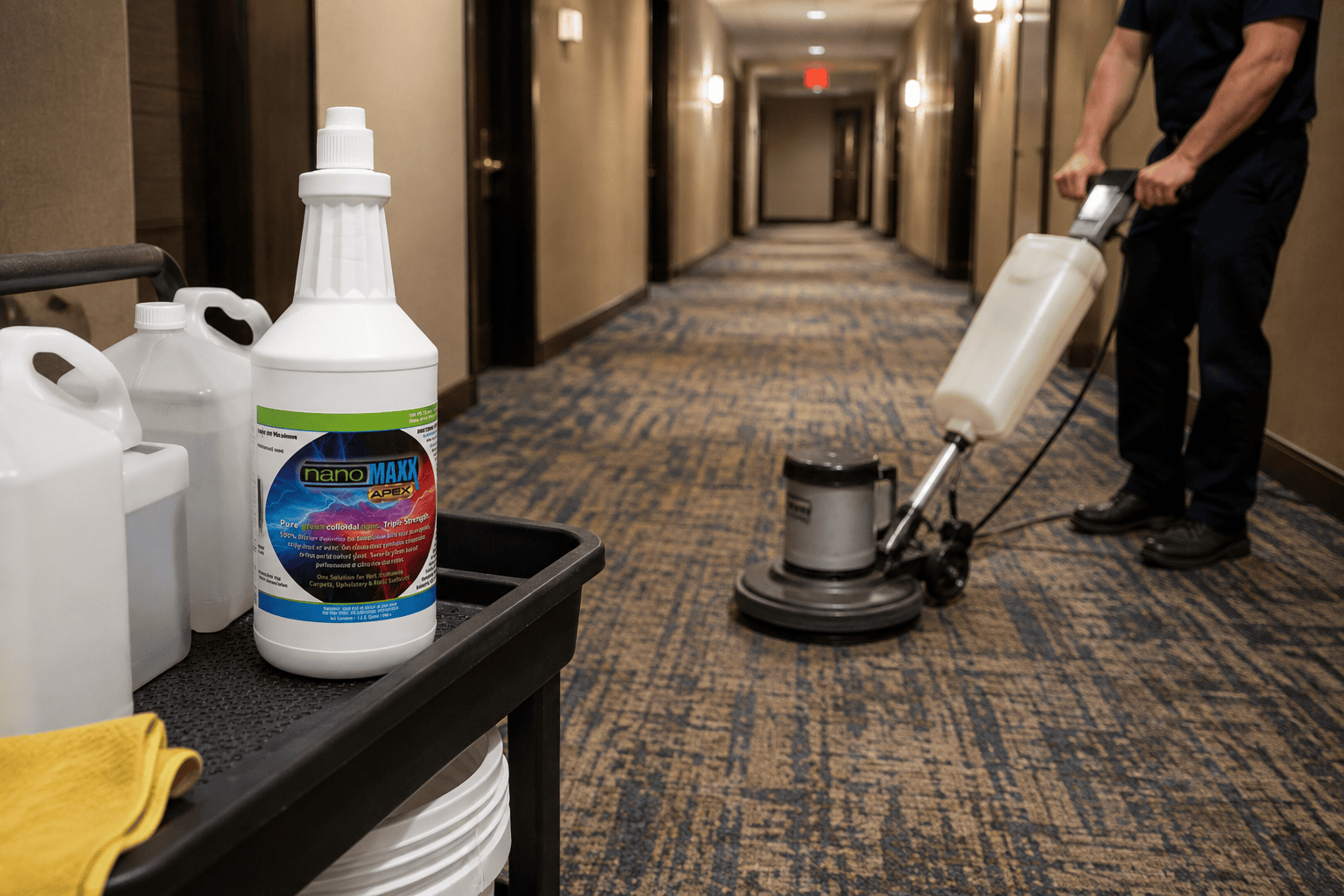
Nano micro-emulsion chemistry reduces particle size in the formula itself, which improves oily-soil and hydrocarbon penetration at a lower use rate than conventional surfactants need. That’s the mechanism behind nanoMAXX APEX, a triple-strength, zero-water concentrate built to hit the practical ceiling of what nano-scale chemistry can pull from a single ounce. Because it skips inert carriers entirely, a quart carries roughly the working power of two cases of a standard product — without the weight or shelf space either case takes up.
Does a More Concentrated Solution Actually Save You Money?
Yes, when the concentrate holds its strength at a low use rate, because fewer case orders and fewer shipments translate directly into lower cost per job. The EPA’s Safer Choice program recognizes concentrated formulas for exactly this reason — less water and packaging moving through the supply chain per use is a real efficiency gain, not marketing language. For a route running maintenance accounts, that means fewer restocks, less van storage tied up, and less time lost mid-season waiting on a shipment.
The catch: that math only works if you’re diluting at the labeled rate. Stretch a bottle past the recommended dilution and you’re trading chemical savings for weaker soil suspension, thinner coverage, and the callbacks that erase whatever you saved on the invoice.
Frequently Asked Questions
How long does a quart of concentrated carpet cleaning solution actually last?
It depends on your dilution rate and use case, but a genuine triple-strength, zero-water concentrate can produce up to 90 RTU gallons for carpet work and up to 150 RTU gallons for hard floors or auto scrubber use from a single quart.
Does over-diluting hurt your results?
Yes. Diluting past the labeled rate reduces active chemistry per gallon, which weakens soil suspension and leads to inconsistent results and faster re-soiling — even though the bottle lasts longer on paper.
Is a triple-strength concentrate safe on all carpet fibers?
A properly formulated non-ionic, neutral-pH concentrate is generally safe across fiber types, including wool and stain-resistant materials, but check the specific pH and fiber compatibility before running it on natural or specialty fibers.
Can one concentrated solution work across carpet, tile,cement,VCT, and upholstery?
Yes — a true multi-surface concentrate is built to function as a carpet cleaner, an upholstery cleaner, a hard-floor cleaner, and a booster for other encap or extraction products, which is a big part of why its real-world yield runs so much higher than a single-purpose detergent.
Stretch Every Bottle Further
If you’ve been running the numbers on the average lifespan of professional carpet cleaning solutions against your own case costs, the real comparison isn’t bottle size — it’s active percentage and dilution rate. nanoMAXX APEX was built to push that number as high as nano-scale chemistry allows, so a single quart replaces multiple cases of a standard product without adding water weight to your van. For more on the chemistry behind that yield, see how nanoMAXX’s nano-scale technology works, and for a broader comparison of green chemistry against traditional detergents on real jobs, read Best Professional Environmentally Safe Carpet Cleaner.