
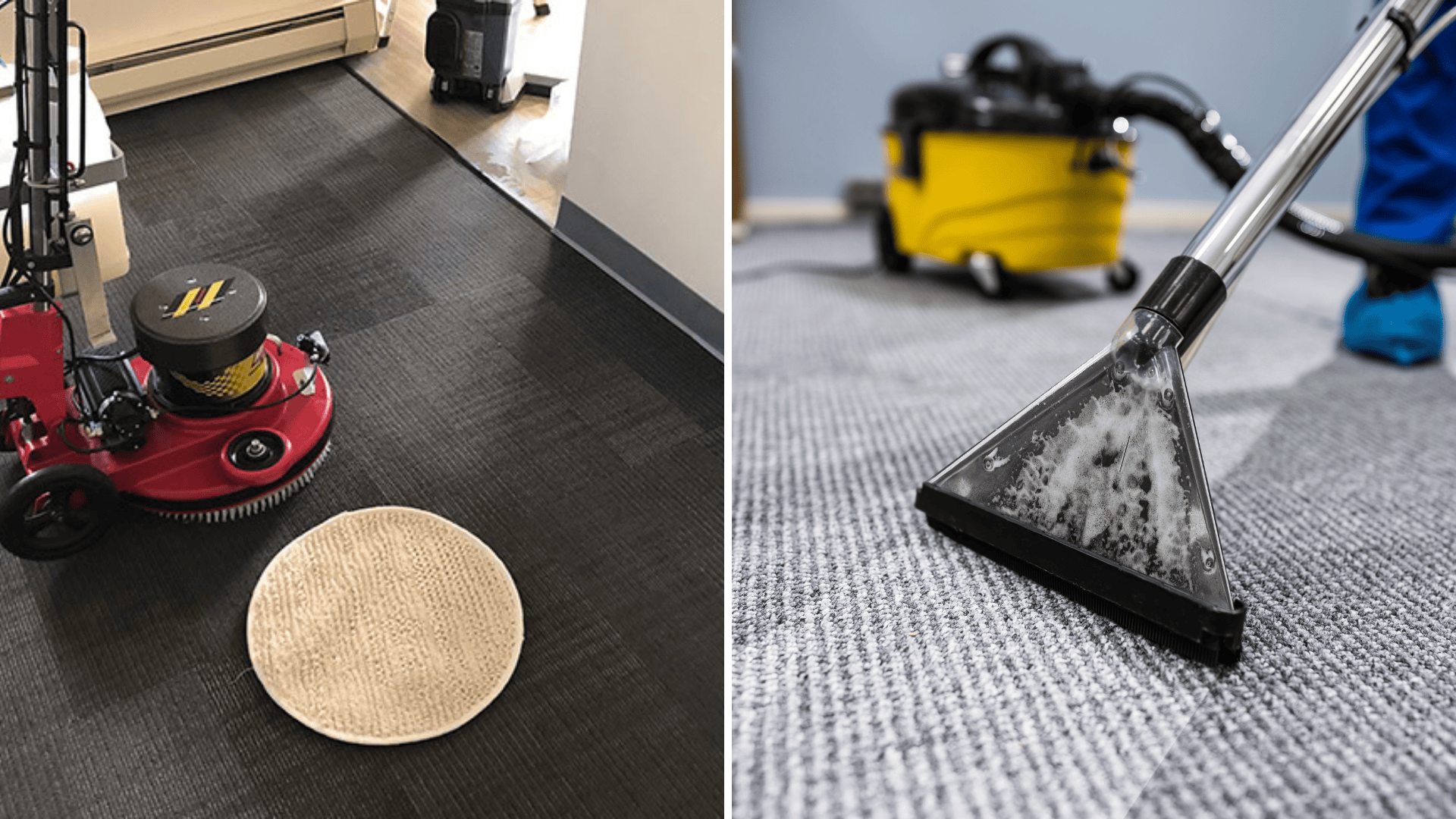
The discussion around bonnet cleaning vs extraction often gets oversimplified. Too many comparisons focus on which method is "better," when the real question for professionals is which method delivers the right result for the job in front of them and yields the highest profits while meeting customer's needs.
In commercial and maintenance cleaning , success isn't measured by how much water you put into the carpet. It's measured by appearance, consistency, dry time, and how efficiently you can maintain that result over time. That's where bonnet cleaning, when done correctly and with the right tools, becomes a primary method rather than a fallback.
How Bonnet Cleaning Works on Modern Commercial Carpet
Professional bonnet cleaning is built on three elements working together: chemical action, agitation, and absorption.
An encapsulation detergent loosens and suspends soil from the fiber. Mechanical agitation breaks the bond between soil and carpet. The bonnet or pad then absorbs and transfers that released soil out of the carpet. When all three are balanced correctly, soil is removed rather than redistributed.
Modern commercial carpets—especially glue-down and low-pile constructions—respond well to this approach. These carpets are designed for durability and frequent maintenance, not saturation. Low-moisture systems allow cleaners to address soil where it sits, without over wetting the backing or extending dry times, plus VLM reduces the possibility of wicking.
Where Extraction Still Has a Place — and Where It Slows You Down
Hot water extraction remains an important tool for restorative cleaning. Heavy contamination, post-flood situations, or severe neglect often require flushing the carpet system.
However, extraction also introduces challenges that make it inefficient for routine maintenance:
- Long dry times that interfere with business operations
- Increased risk of wicking in commercial carpet
- Labor and setup time that doesn't scale well for frequent cleaning
In many cases, extraction is used simply because it's familiar, not because it's the best match for the job. That's where bonnet cleaning often delivers better outcomes with fewer downsides.
Bonnet Cleaning vs Extraction in Real-World Commercial Settings
In commercial environments, cleaning decisions are driven by traffic patterns, operating hours, and appearance expectations, not theory. Facility managers rarely ask how much water was used. They care about how the carpet looks tomorrow morning and how long that result lasts.
Commercial Carpet Is Built for Maintenance, Not Saturation
Most commercial carpet—especially glue-down and low-profile styles—is designed to handle frequent cleaning. It is not designed to be saturated on a regular basis.
Hot water extraction has a role, but when used too often in these settings it can create challenges:
- Extended dry times that interfere with business operations
- Increased risk of wicking in traffic lanes
- More downtime between cleaning and normal use
Bonnet cleaning works with the construction of commercial carpet instead of against it. By relying on agitation and absorption rather than flushing, cleaners can address soil at the surface and upper fiber level without wetting the backing.
High-Traffic Areas Demand Frequent, Controlled Cleaning
Entrances, corridors, elevator lobbies, and main walkways accumulate soil faster than the rest of the building. These areas are also the most visible.
Bonnet cleaning allows professionals to:
- Target traffic lanes without cleaning the entire facility
- Restore appearance quickly using absorbent IronMan cotton bonnets
- Rotate bonnets as they load with soil to maintain consistent results
High-absorption cotton bonnets, such as IronMan™ Carpet Bonnets, are particularly effective here. Their ability to absorb suspended soil and provide consistent friction allows for measurable soil removal rather than surface polishing.
Limited Downtime Changes the Method Selection
Offices, healthcare facilities, schools, and hospitality spaces often have narrow cleaning windows. Carpets need to be dry and ready for use as soon as possible.
Low-moisture bonnet cleaning supports these requirements by:
- Delivering fast, predictable dry times
- Reducing slip hazards and access restrictions
- Allowing cleaning during overnight or short maintenance windows
Adding controlled agitation with tools like a Multii Brush system improves chemical penetration and soil release without increasing moisture, helping maintain results even under tight schedules.
Why Bonnet Cleaning Often Delivers Better Results Than Extraction
One of the biggest differences in the bonnet cleaning vs extraction discussion comes down to friction versus flushing.
Extraction relies on water pressure and suction. The wand itself applies minimal mechanical action to the carpet surface. If soil is compacted between fibers, flushing alone can only do so much.
Bonnet cleaning introduces controlled friction directly at the fiber level. That friction loosens packed-in soil and transfers it into an absorbent medium and scrubs the face fiber removing the oily binders and bio films much for effectively. When paired with the right encap detergent, this approach often produces more visible improvement, especially on commercial carpet that isn't heavily contaminated but sees constant traffic. And did you know the bonnet cleaning can also be a good choice for residential carpets for the same reasons listed in this article?
How Cotton Bonnets Make a Measurable Difference
Not all bonnets perform the same, and material choice has a direct impact on results.
High-quality cotton bonnets, like IronMan™ Carpet Bonnets by ProCotton, provide two critical advantages: absorbency and friction. Cotton naturally absorbs more moisture than synthetic or microfiber alternatives, allowing it to pull more suspended soil out of the carpet with each pass. At the same time, cotton fibers create greater surface friction, which improves soil release during agitation.
In side-by-side testing using the same machine and carpet, cotton and synthetic tufted bonnets consistently show a difference. The cotton bonnets remove more soil, clean more evenly, and maintain performance across repeated jobs.
IronMan™ bonnets are designed for durability as well as performance. They glide smoothly under rotary and OP machines, reduce operator fatigue, and hold up wash after wash without shedding. For professionals who rely on bonnet cleaning as a primary method, that consistency matters.
When Encapsulation Pads Outperform Traditional Bonnets
There are situations where absorption alone isn't enough. Packed-in soil, heavily trafficked glue-down carpet, or uneven soiling often require more aggressive mechanical action.
This is where Revive Fiber Encap Pads and Revive Plus Encap Pads come into play. These pads are designed to deliver significantly more scrubbing power than traditional bonnets. Their fiber construction, reinforced with hog's hair, creates aggressive contact with the carpet surface while remaining low-moisture.
In some cases, this level of agitation can outperform hot water extraction. While extraction wands glide over the surface, Revive pads actively scrub between fibers, loosening soil that flushing alone may leave behind.
Revive pads also reduce downtime and labor. Each pad can clean thousands of square feet before needing to be flipped or replaced, which means fewer interruptions during large jobs and no piles of dirty bonnets to launder afterward.
Spot Treatment Without Switching to Extraction
Not every stain requires a full extraction setup. Organic spills like coffee, wine, or food stains can often be addressed within a bonnet cleaning system.
Revive iT Oxy Spotter allows cleaners to pre-treat organic stains effectively while staying low-moisture. Its stabilized hydrogen peroxide activates when it contacts soil, making it safe, efficient, and compatible with bonnet and encapsulation workflows. This keeps jobs streamlined and reduces unnecessary equipment changes.
Bonnet Cleaning vs Extraction: Making the Right Call for the Job
The real decision isn't bonnet cleaning vs extraction. It's choosing the method that fits:
- Soil load
- Carpet type
- Downtime requirements
- Maintenance schedule
For many professionals, bonnet cleaning becomes the primary system because it delivers repeatable results, scales efficiently, and aligns with commercial client expectations.
Scaling Your Cleaning Results with Bonnet Pro
Building a reliable bonnet cleaning service requires more than just machines. It depends on quality tools, effective chemistry, and proven methods.
Bonnet Pro supports professionals with quality bonnets designed for real absorption, high-performance encapsulation pads for aggressive scrubbing, and chemistry that works across low-moisture and extraction workflows. Just as important, Bonnet Pro provides education and product guidance that helps cleaners refine their methods and scale their services with confidence.
For professionals focused on improving consistency, efficiency, and results, Bonnet Pro isn't just a supplier—it's a partner in building better cleaning systems.