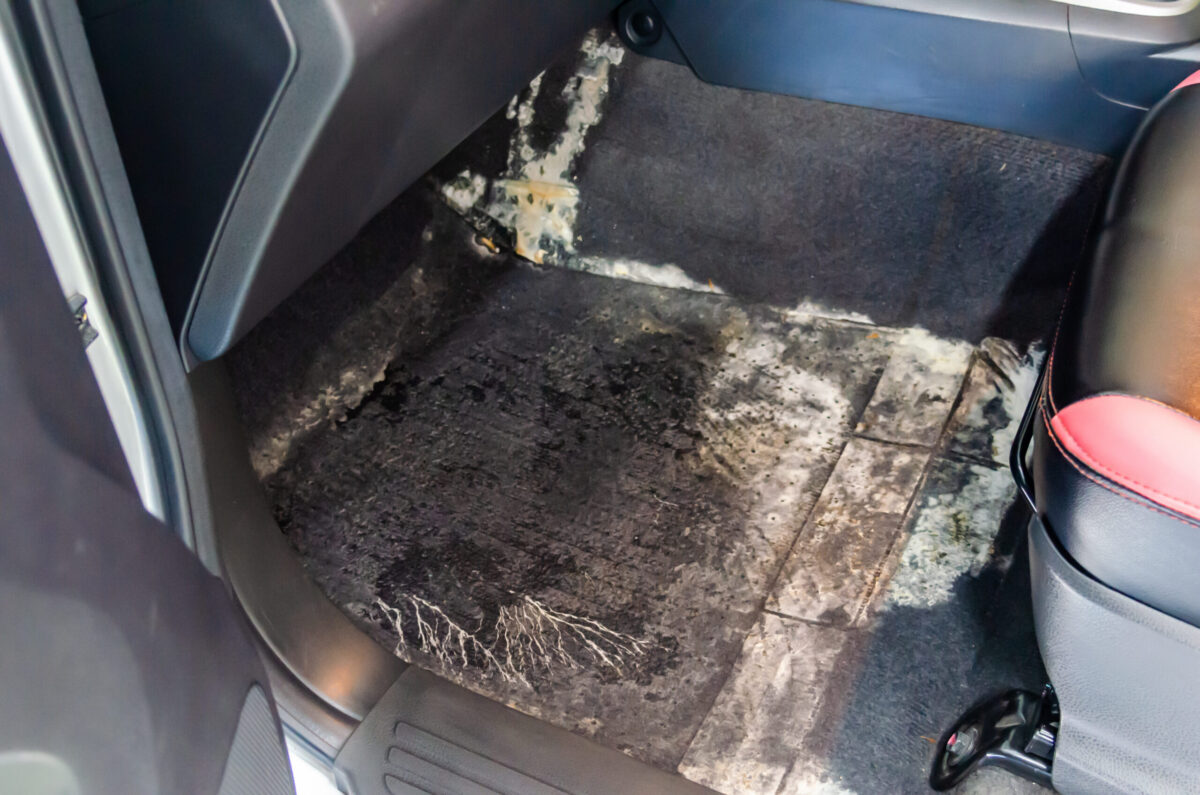
Salt stains are one of the most misunderstood problems in professional auto detailing. Most detailers treat them like a regular carpet spot or stain — spray, scrub, extract — and then wonder why the white residue keeps coming back, or why the carpet feels damp days after cleaning. The reality is that salt behaves like a mineral deposit, not a conventional soil, and it requires a specific chemical approach to remove completely. This guide covers the chemistry, the right products, and a professional step-by-step process for how to remove salt stains from car carpet without the guesswork.
The Chemistry Behind Salt Stains — and Why It Changes How You Treat Them
Road salt, sea salt tracked in from the beach, and sweat residue all leave behind ionic mineral compounds that interact with carpet fiber in ways ordinary soiling does not. Here is what is actually happening when salt gets into car carpet:
- Salt is water-soluble when wet — meaning it migrates deep into the fiber and backing before it ever dries
- When it dries, it crystallizes — forming hard mineral deposits that are physically embedded in the fiber structure, not just sitting on the surface
- Salt is hygroscopic — it actively draws moisture from the surrounding air, which is why salt-stained carpet often feels persistently damp or clammy even after it appears dry
- Most standard carpet shampoos and extraction pre-sprays used in auto detailing dissolve surface-level salt crystals but leave enough salt in the mid- and lower-pile to recrystallize — particularly when they lack encapsulation chemistry to hold dissolved ions in suspension through drying
- High-alkaline cleaners compound the problem — by leaving their own residue behind, they interact with the mineral deposits and make the fiber harder to clean on subsequent passes
The practical takeaway is that removing salt buildup from car carpet requires chemistry that dissolves the crystalline mineral deposits completely, suspends them in solution, and removes them from the full depth of the fiber — not just the surface layer.
Why Encapsulation Outperforms Conventional Car Carpet Cleaner on Salt
A standard car carpet cleaner dissolves surface salt, extracts some of it, and leaves the rest to recrystallize. An encapsulation formula surrounds the dissolved mineral ions in a polymer coating that holds them away from the fiber as the product dries, releasing them as a dry residue during the final vacuum.
The result is a fiber that is genuinely clean rather than one that looks clean immediately after treatment and turns white again by morning. The pH of the product matters here too — salt deposits sit at near-neutral pH, which means neutral-pH encapsulation chemistry dissolves and suspends them most efficiently. High-alkaline or high-acid products disturb the ionic balance of the deposit without fully removing it, often leaving a different type of residue behind.
Best Salt Remover for Car Carpets: The Bonnet Pro System
Three products from Bonnet Pro's professional line form a complete and chemically logical system for salt stain removal in auto carpet.
Surround Omega Citrus — The Lead Product
Surround Omega Citrus is the primary tool in this workflow for several reasons that map directly onto the chemistry of salt stains.
Why it works on salt:
- Neutral pH of 6.5 to 7.5 dissolves mineral deposits without leaving secondary residue
- T3H Dustless, Soil Encapsulating Polymers encapsulate the dissolved mineral ions and hold them suspended through the drying process
- Built-in antimicrobial agent addresses the moisture retention problem — salt-stained carpet that has been damp for extended periods often develops bacterial growth in the fiber, and Omega Citrus treats this simultaneously
- Zinc-based odor neutralizers handle the musty smell that chronically damp, salt-stained carpet develops over a winter season
Best application scenarios:
- Vehicles with road salt buildup across floor carpet
- Coastal vehicles with sea salt tracked in repeatedly over time
- Any car where salt staining has caused persistent dampness or odor
Revive iT Rocket — The Follow-Through Cleaner
Road salt rarely arrives in a car carpet alone. It typically comes in mixed with petroleum residue from road surfaces, mud, and general grime. Revive iT Rocket's citrus-oxy encapsulation formula handles this mixed contamination after Omega Citrus addresses the primary mineral deposits.
What Rocket adds to the system:
- Citrus solvent cuts through any petroleum-based road grime accompanying the salt
- SSHP peroxide addresses residual gray or yellowish discoloration left in the fiber after salt removal
- AFT (Active Film Technology) leaves a protective film on the fiber that resists future soiling — relevant on vehicles that will continue to see salt exposure through the season
Revive iT Oxy Spotter — For Residual Discoloration
Salt itself is colorless, but the combination of road salt with road grime and organic material often leaves a grayish or brownish discoloration in the carpet fiber after the mineral deposits are removed. Oxy Spotter's SSHP peroxide addresses this residual staining with targeted oxidizing chemistry, brightening the fiber back to its original appearance.
When to reach for Oxy Spotter in this workflow:
- After Omega Citrus and Rocket passes, if visible discoloration remains
- On light-colored or beige carpet where even faint residual staining is cosmetically unacceptable
- On set-in salt staining where the gray discoloration is deeply embedded
How to Remove Salt Stains from Car Carpet: Step-by-Step
Step 1 — Dry Vacuum Before Any Wet Chemistry
This step is more important with salt stains than almost any other soil type. Loose salt crystals on the carpet surface will dissolve immediately when wet chemistry is applied — creating a more concentrated saline solution that drives deeper into the fiber. Removing as much dry crystalline material as possible before introducing moisture limits how deep the dissolved salt can penetrate.
Use a high-suction vacuum with a stiff-bristle attachment if available. Make multiple passes in different directions to dislodge crystals from different angles in the pile.
Step 2 — Pre-Mist to Rehydrate Deep Deposits
Before applying Surround Omega Citrus, pre-spray deposits and entire surface — this begins rehydrating the deeper crystalline deposits so they are already in a dissolved state when the encapsulation chemistry arrives. Allow the pre-mist to sit for one to two minutes, or more for heavy buildup — enough time for moisture to reach deposits in the lower pile without saturating the carpet.
Step 3 — Apply Surround Omega Citrus
Mix Omega Citrus into a spray bottle at a stronger concentration than you would for general cleaning — salt deposits need more product contact to fully dissolve and encapsulate. Apply generously, covering:
- The full visibly stained area
- At least two inches beyond the stain boundary in every direction
- Any areas that feel damp or clammy to the touch even without visible white residue
Allow a dwell time of five to eight minutes. The encapsulation polymers need adequate contact time to fully surround the dissolved mineral ions before agitation begins.
Step 4 — Agitate Through the Full Pile Depth
Use a medium-stiffness detail brush or drill brush at low speed. With salt stains, you are not scrubbing the stain loose — you are working the chemistry through the full depth of the pile so the encapsulation polymers reach every dissolved salt crystal, including those in the lower fiber layers.
Agitation technique for salt stains:
- Use slower, more deliberate strokes than you would on a regular stain
- Work in multiple directions — with the pile, against it, and laterally — to ensure complete penetration
- Pay particular attention to carpet edges and seams where salt accumulates heavily
Step 5 — Extract
For detailers working with a portable extractor, make multiple vacuum-only passes then flushing passes over the treated area until the solution runs clear. The salt-contaminated solution needs to be physically removed from the carpet, not just redistributed. A rinse with Acid LAVA can also be helpful here.
Step 6 — Apply Revive iT Rocket
Apply Rocket from a spray bottle across the full treated area and slightly wider. This pass addresses any road grime that came in with the salt, brightens the fiber with the peroxide component, and deposits AFT protection. Agitate lightly, allow one to two minutes of dwell, and extract or blot.
Step 7 — Assess for Residual Discoloration
Allow the carpet to partially dry — about ten minutes — and assess under good lighting. Salt deposits themselves will be gone at this point. If gray or brownish discoloration remains from road grime or organic material that accompanied the salt:
- Apply Revive iT Oxy Spotter directly to the discolored area
- Allow ten minutes of dwell
- Agitate gently with a soft brush
- Blot or extract
Step 8 — Final Dry and Vacuum
Allow the carpet to dry completely. Encapsulation chemistry dries significantly faster than conventional car carpet cleaner — typically 20 to 40 minutes in normal conditions. The final vacuum pulls the dried polymer crystals loaded with dissolved mineral ions out of the fiber, completing the cleaning cycle. Do not return the vehicle before this step is done.
Three Specific Scenarios That Require Extra Attention
Heavily Salted Vehicles With a Full Season of Buildup
Cars driven through an entire winter often have salt contamination layered through the carpet from multiple cycles of exposure, partial drying, and re-exposure. On these vehicles, run two full Omega Citrus passes before the Rocket follow-through. The first pass dissolves and removes the surface and mid-pile deposits. The second pass reaches the deeper layers that the first pass rehydrated but didn't fully suspend.
Carpet That Feels Persistently Damp After Previous Cleaning Attempts
If a vehicle comes to you with carpet that feels perpetually damp despite previous cleaning, the issue is almost certainly that earlier treatments dissolved surface salt but left enough in the padding below to continuously draw atmospheric moisture. This requires a more saturated Omega Citrus application with a longer dwell time — up to ten minutes — followed by thorough extraction and rinsing with Acid LAVA. Without extraction capability on a vehicle like this, results will be limited.
Salt Combined With Physical Carpet Wear
Road salt is abrasive. On vehicles where heavily salted floor mats have been sitting on carpet for an extended period, the pile beneath the mat may show physical wear alongside the staining. Clean the contamination with the standard workflow, but set accurate expectations — discoloration from staining can be removed, but fiber abrasion from salt crystals is physical damage that cleaning cannot reverse.
Knowing how to remove salt stains from car carpet professionally comes down to one core principle: salt is a mineral deposit, and it responds to mineral deposit chemistry. The combination of Surround Omega Citrus as the lead encapsulation cleaner, Revive iT Rocket for mixed contamination and fiber protection, and Revive iT Oxy Spotter for residual discoloration gives you a system that addresses every dimension of the problem — dissolved mineral deposits, road grime, persistent dampness, odor, and long-term resoiling resistance. Detailers who treat salt stains with this system stop seeing white residue return after cleaning. That result is what builds the kind of reputation that generates referrals.